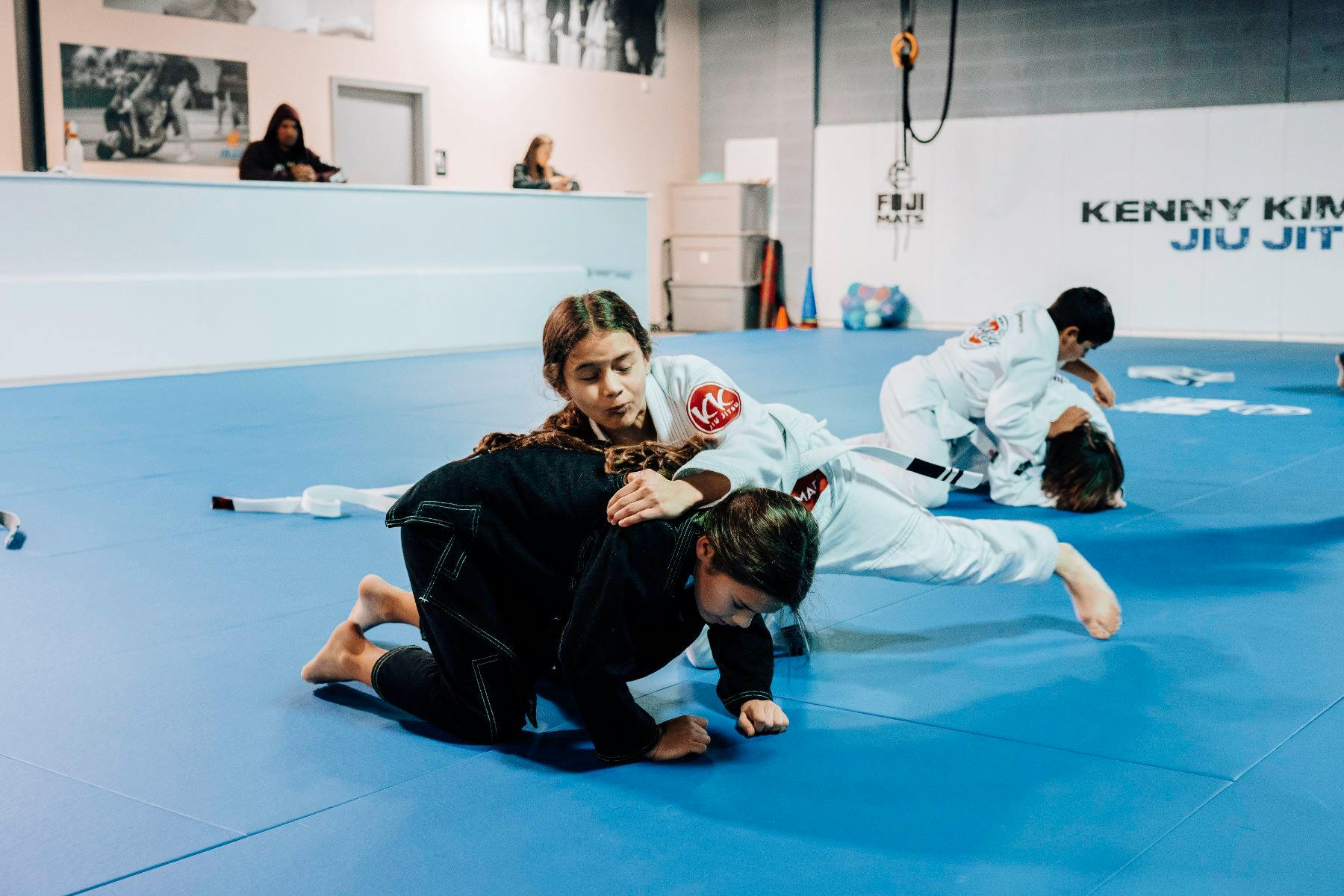
The art & science
A grappling martial art where leverage, technique, and positional control beat size and strength. It's the most practical self-defense discipline in the world — and one of the most demanding, rewarding sports you can practice.
The core idea
"A smaller, weaker person can control and overcome a larger, stronger opponent — using leverage, grip, and superior positioning."
Brazilian Jiu-Jitsu was developed in Brazil in the early 20th century, adapted from Japanese Judo by the Gracie family. Where striking arts end a fight quickly, BJJ is a chess match — one that rewards intelligence, patience, and technique over power.
Training happens on the ground. You learn to take opponents down, control their position, and apply submission holds (joint locks and chokes) that force them to tap out. Because there's no striking, you can practice full-speed against fully resisting partners every single day — which is why BJJ produces such capable practitioners so quickly.
It's one of the few martial arts where a 140-pound woman can genuinely control a 200-pound man. Not in theory — in practice, on the mat, proven every day in gyms around the world.
And the side effects are significant: elite-level fitness, mental toughness, a sense of calm you can't fake, and a community of people who will become some of your closest friends.
Experience it yourself →What training does to you
An hour of BJJ burns more calories than most gym workouts. You'll build real functional strength, improve flexibility, and develop cardiovascular fitness — because you can't fake your way through a five-minute roll.
You will get submitted. You will feel lost. Learning to stay calm when someone is trying to choke you — and to problem-solve your way out — develops a kind of mental resilience that transfers to everything else.
When you're rolling, nothing else exists. Work, relationships, to-do lists — all of it disappears for an hour. Students consistently report BJJ as the most effective stress relief they've ever found.
Real self-defense that works against resisting opponents. BJJ is a foundational component of MMA for a reason — it's been tested against every other martial art and proven itself repeatedly.
BJJ is called "human chess" for a reason. Every roll is a puzzle. You develop the ability to think under pressure, recognize patterns, and execute solutions calmly — skills that show up everywhere.
Something about struggling through something hard together creates unusually strong bonds. The BJJ community is known for being welcoming, ego-free, and genuinely supportive — because everyone remembers being a beginner.
Nervous? Good.
Everyone remembers their first class. It's okay to be nervous — you should be. Here's exactly what will happen so there are no surprises.
Show up in athletic clothes
No gi required for your first class. Shorts and a t-shirt work fine. We'll talk about gear after you decide you want to train.
Meet an instructor
Tell them you're new. They'll introduce you to the class, explain what's happening, and make sure you're with someone appropriate for your first roll.
Warm-up together
Classes start with a structured warm-up: movement drills, conditioning, and BJJ-specific exercises to build body awareness.
Learn techniques
The instructor demonstrates moves. You drill them with a partner at your own pace. No one expects you to get it right the first time — or the tenth.
Live rolling (optional for day one)
At the end of class, students roll (grapple) with each other. As a new student, you'll be paired carefully. You'll lose — and that's the best thing that could happen to you.
Common questions
Zero experience required. Our fundamentals classes are designed specifically for beginners — you'll be surrounded by other new students and guided through every technique step by step.
No. BJJ is one of the few martial arts where age and fitness improve over time with training — not prerequisites for starting. We have students in their 50s who started with no fitness base. The mat will get you in shape; you don't need to arrive in shape.
BJJ is a contact sport, so minor bumps happen. But because there's no striking, injury rates are comparable to soccer or basketball — far safer than most combat sports. We're explicit about safety culture: tap early, train with respect, look out for your training partners.
Gi BJJ uses the traditional uniform (the kimono). You grab the fabric, which changes available techniques and creates a slower, more methodical game. No-Gi is training in shorts and a rash guard — faster, more dynamic, closer to wrestling or MMA. We offer both.
BJJ has the longest belt progression of any martial art — typically 10+ years of consistent training to black belt. The belts are: white → blue → purple → brown → black. Each represents real, tested proficiency. Getting your blue belt (usually 1–2 years in) is a genuine achievement most students are proud of.
Especially good. BJJ was built on the principle that technique beats size — which means it's one of the few martial arts where a smaller woman can genuinely control a larger attacker. We have a strong women's training community here and a zero-tolerance policy for any behavior that makes anyone feel unwelcome.
The best way to understand it
One class is worth a thousand articles.